




Blog
Bored Piles vs CFA Piles in the UAE: How to Choose the Right Foundation System

Choosing between bored piles and Continuous Flight Auger (CFA) piles is one of the most important early decisions in a deep-foundation package. Both systems create cast-in-place reinforced concrete piles, but the way they are installed, monitored and matched to ground conditions is different. For developers, consultants and main contractors in the UAE, the correct choice should come from the geotechnical profile, structural loads, groundwater, neighbouring assets, working space and construction programme – not from a preference for one method.
Why pile selection matters in the UAE
Foundation conditions can change considerably from one plot to another. Fill, loose or dense sands, cemented layers, groundwater and variable rock horizons can all influence pile behaviour and constructability. Dubai Municipality maintains requirements and procedures related to soil and foundation testing, pile load tests and foundation or excavation levels, which reinforces a basic project principle: foundation decisions need verified ground information and project-specific engineering. A piling method that performs efficiently on one site may be unsuitable on another.
What is a bored pile?
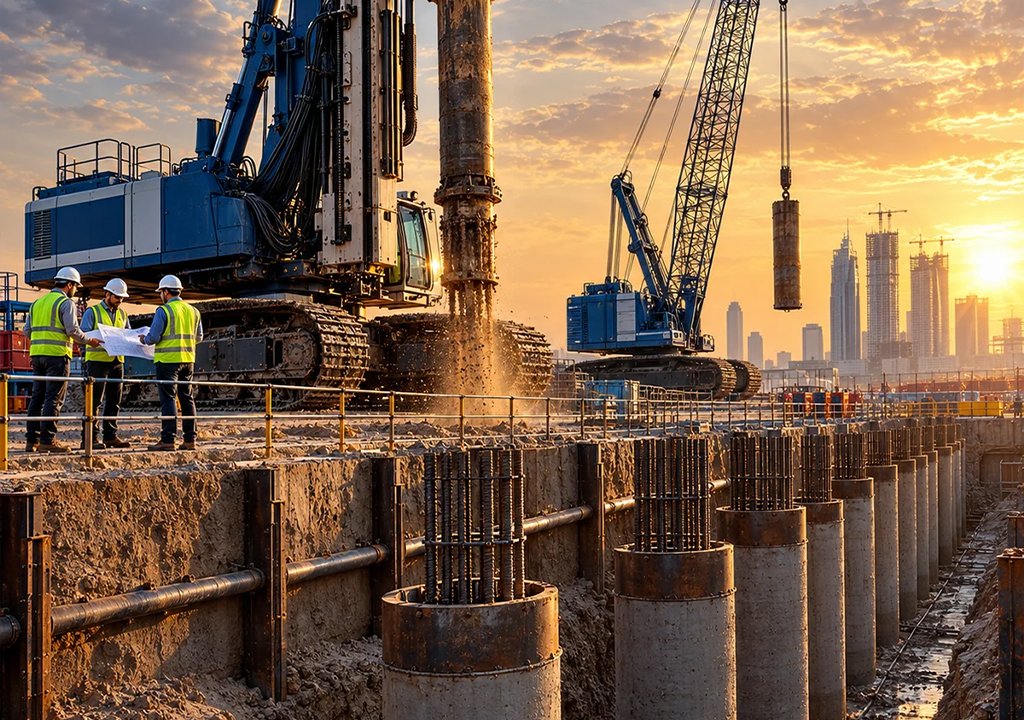
A bored pile is formed by drilling a circular bore to the required depth, supporting the bore where necessary, lowering the reinforcement cage and placing concrete. Bored piles can accommodate a broad range of diameters and depths and are widely used where high structural loads or substantial pile capacity are required. Depending on the ground and groundwater, temporary casing or an approved support fluid may be used to maintain bore stability during construction.
What is a CFA pile?
A CFA pile is installed with a continuous flight auger. The auger is drilled to the design depth and concrete is pumped through the hollow stem while the auger is withdrawn. Reinforcement is inserted into the fresh concrete after concreting. Because there is no impact driving, CFA piling can be attractive on projects where noise and vibration need to be controlled. Its continuous installation cycle can also support efficient production when the soil profile, pile dimensions and reinforcement requirements suit the method.
Bored piles vs CFA piles: the practical differences
Bored piles provide significant flexibility for large diameters, deep founding levels and heavy loads. The open-bore construction sequence also allows specific inspection and cleaning activities before concreting, subject to the approved method. CFA piling uses a more continuous drilling-and-concreting process. It can reduce the number of separate bore-construction stages and may deliver strong production rates, but the concrete pumping, auger extraction and reinforcement insertion sequence must be carefully controlled. Neither method is universally better. The correct method is the one that satisfies the approved design and can be constructed reliably under the actual site conditions.
Seven factors to review before selecting the pile type
- Structural load and settlement criteria: higher loads or strict settlement limits can influence pile diameter, depth and system choice.
- Ground profile: loose soil, dense layers, obstructions and rock affect drilling and installation.
- Groundwater: bore stability and concrete placement procedures must respond to water conditions.
- Access and working platform: rig size, headroom, movement and platform capacity matter.
- Adjacent structures: vibration, noise and allowable ground movement may restrict methods.
- Reinforcement requirements: cage length and stiffness need to suit the installation sequence.
- Programme and logistics: concrete supply, spoil handling, testing and production targets should be considered together.
Quality control should influence the decision
Pile quality is created during installation. For bored piles, controls commonly include setting out, bore depth, bore stability, base condition, reinforcement placement and concrete records. For CFA piles, drilling depth, concrete pressure and volume, extraction rate and reinforcement installation are important construction records. The project specification may also require load testing, integrity testing or other verification. Selection should therefore consider not only how quickly a pile can be installed, but how confidently its construction can be controlled and documented.
Which method is suitable for your project?
For a high-load structure requiring large pile diameters or deep founding levels, bored piles may offer the required flexibility. For repetitive pile layouts in suitable ground where low vibration and an efficient continuous process are priorities, CFA piles may be considered. Complex sites can also require more than one foundation or ground-support technique. PDS Piling reviews the approved design, available geotechnical information, access and programme requirements before planning the construction method for bored piling, CFA piling and related foundation works across the UAE.
Talk to PDS Piling before mobilisation
Early construction planning helps identify working-platform requirements, rig access, concrete logistics, spoil routes, testing interfaces and neighbouring constraints before they become programme problems. PDS Piling & Foundation Contracting LLC supports bored piles, CFA piles, micropiles, shoring, ground anchors, drilling and excavation in Dubai, Abu Dhabi and other UAE locations. Share your drawings, pile schedule and available ground information with our team for a project-focused discussion.
Frequently Asked Questions
Are CFA piles cheaper than bored piles?
Cost depends on pile dimensions, quantity, soil conditions, concrete and reinforcement, mobilisation, testing, access and programme. A method should not be selected on unit rate alone.
Which pile type creates less vibration?
Both bored piles and CFA piles are drilled systems and generally create less vibration than impact-driven piling. Actual site effects still depend on equipment, ground and nearby structures.
Can CFA piles be used for high-rise buildings?
CFA piles can support substantial loads when designed for the project, but suitability depends on pile dimensions, reinforcement, ground profile and structural requirements.
Can bored piles be installed below groundwater?
Yes, with an approved method for bore support and concrete placement. The exact procedure depends on the ground and groundwater conditions.
How is pile capacity verified?
Capacity is established through design and may be verified by project-specified load testing and other tests or observations.
Does PDS Piling provide both bored and CFA piling?
Yes. PDS Piling provides bored piles and CFA piles along with other foundation and ground-support services in the UAE.